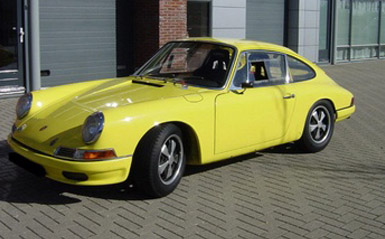
Our pick of the ten classics every enthusiast should know — what made them special, and what to look for if you’re tempted to buy one.
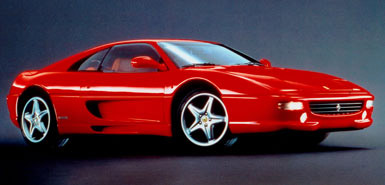
1. Ferrari 355 Berlinetta
Launched in September 1994, the 355 was a big step forward for Ferrari. At £83,000 it hardly cost more than the 348 model but it was quicker, more powerful and much better looking.
The Power came from the 3.5 litre V8 engine and for the first time, five valves per cylinder. With 375bhp and a kerb weight of just 2,846lb, the performance was amazing with speeds of 0-60mph in just 4.6sec and on to 100mph in 10.8sec.
By September 1995 the Spyder joined the group and it was 130lb heavier than the Berlinetta.
A used Spyder will cost you about £5,000 more than the Berlinetta In 1997 the 355 gained the option of an F1 “automatic” gearbox to supplement the six-speed manual. It allowed drivers to change up or down via two paddles on the steering column and to move through the gears more quickly than with a standard manual gear box.
Owning a Ferrari is not about buying a car it’s about becoming part of a motoring masterpiece. After the heavy fuel consumption and high insurance premiums have faded, the memory of the 355’s surging power, intoxicating engine note and breathtaking beauty will remain.
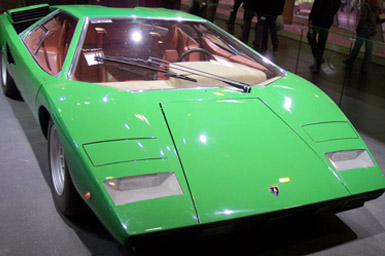
2. Lamborghini Countach
Hear the name Countach and you instantly visualise the most striking supercar of the past 25 years. While bewildering permutations of Ferraris come and go, you know what you're getting with the Countach, whether in its purest early form as styled by Marcello Gandini, or the updated iterations buried under scoops and wings: a pure performance wedge, powered by a longitudinal V12 of 4 or 5 litres.
It was to have been known by the model number only, but the story goes that, when Gandini's boss Nuccio Bertone saw the first car wheeled out of the workshops, he exclaimed 'Countach', a local Piedmontese expression of amazement for which there is no literal translation, and a legend was born.
The design is quite straightforward, and the engines, as one specialist puts it, are 'bulletproof', but there's a lot of it and things do break. It is possible to care for a Countach for less than £500 per year, but the cars' very mystique can generate big bills.
The Countach's structure - including those startling reach for-the-sky flip-up doors - is of hand-formed aluminium skins riveted over a steel tube superstructure on top of a complex latticework chassis. Headlight pods are steel, and so are the roofs on later cars. Because of hand-building, no two cars are exactly alike - and, crucially, the bodies are very susceptible to corrosion When buying one, don't worry too much about corrosion because you can see most of the chassis, but avoid cars that have been heavily shunted. Spot these by trim that doesn't quite fit, or rippled aluminium panels that have been smoothed with filler.
With the Countach a decade out of production, you can drive the same wheels as Rod Stewart loved without having to claim irony: this period piece would make a great alternative to that 248 you were lusting after.
3. De Tomaso Pantera
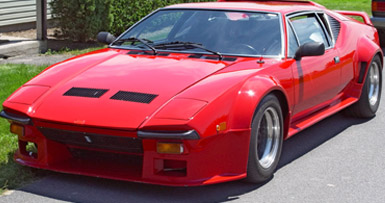
The De Tomaso Pantera is a piece of automotive exotica every bit as seductive as a Ferrari, Lamborghini or Porsche. But you know when an Argentinean car is built in Italy with 5.7 litres of V8 muscle, you’re in for an interesting ride.
The first Pantera rolled off the Italian production line in 1971, and was one of the first truly international supercars ever made.
Using similar materials as its neighbours in Modena (the home of Ferrari), its Argentinean founder Alejandro De Tomaso took advantage of his close relationship with Ford to supply him with gutsy V8 engines.
It looks amazing today, so imagine the reactions that it would have received at its launch in 1971.
It was a pure muscle car engine. The original 5.7 litre V8 that sat behind the seats produced a hair-raising performance. The accelerator, and the lucky driver would be passing the 60mph 5.5 seconds later and on to a top speed of 159mph.
That's not even mentioning the growl that would come from its engine and exhaust. The sound which became known as the Pantera sound, could shake the ground beneath its wheels and could - more than likely - wake the dead.
Later models would get even scarier and faster. The last-of-the-line GT5 S were regarded as the best Panteras ever made - shaving 0.1 seconds from the 0-60 time and raising the top speed to 165mph.
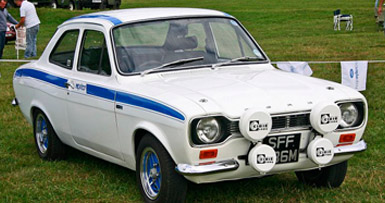
4. Ford Escort Mexico 1974
Although the escort was mainly known as an estate and was a very popular car it was replaced for the hugely popular Anglia car, back in 1968.
About 18 million Fords have been produced at the joint venture factories in England and Germany. 1970 also saw the launch of the more basic Mexico, to cash in on Ford's success in the London to Mexico rally it featured a basic 1599cc ohv kent engine in standard form and produced around 86bhp.Complete with bold side stripes it was a good entry level 'fast escort'.
The Escort Mexico was named after its rally victory in 1970.
Legend has it, that the Mexico was the first Boy Racer car, and inspired the RS2000 to be produced 4 years later in 1974. 1980 Ford saw the introduction of the mark 3 Escort, which died out in 1990 and was replaced by the last, and most reformed model.
Cosworth found fame with their variation of the Escort Cosworth, an Insurance company’s nightmare.
Other famous Escort drivers were Sarah Ferguson and the late Princess of Wales.
5. Aston Martin DB2
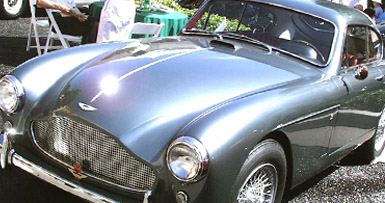
Aston Martin made its reputation in the 1930s with 1.5-litre sports cars that were stylish, reliable and ideal for endurance racing Like most small manufacturers, Aston Martin has hit frequent crises, but there's always someone ready to rescue it. This year, it's the rallying guru Dave Richards, but just after the Second World War, it was David Brown. The DB2 that went on sale in 1950, at £1,920, was derived directly from the lightweight racer, with small revisions. The windows had opening quarter-lights, the large cooling vents in the front wings had gone, and well-heeled customers could opt for a coupé or a convertible, both two-seaters panelled in aluminium, with a gear-lever mounted on the floor or steering column.
Standards of finish and trim were top-notch, but the DB2 betrayed its origins as a competition machine.
The coupé's tiny rear window gave rotten visibility, and the luggage area could be loaded only from inside. However, the bonnet hinged forward for superb access. In standard form, the DB2 had 105bhp, with a 125bhp Vantage engine optional, and this label has been used since by Aston for its high-performance models. It offered 116mph and 0-60mph in 11.2 seconds, which was no match for the Jaguar XK120, but the Aston package was sensational – roadholding, style, quality and sheer character. From being a make of appeal mainly to racing anoraks, Aston Martin was now the first purveyor of a race-bred yet refined GT car.
It was twice as expensive as the Jag, but only two-thirds the price of a Ferrari.
6. Bentley Continental Flying Spur 1960
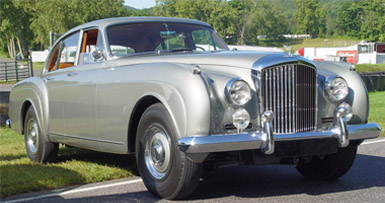
The first Bentley Continental Flying Spur was seen at a Paris show in 1960.
The Bentley S2 (and Bentley S2 Continental) was a luxury car produced by Bentley from 1959 until 1962.
Based on the Rolls-Royce Silver Cloud II, the S2 replaced the straight-6 engine of the Bentley S1 with a new aluminum V8 engine displacing 6.2 L (6230 cc/380 in³). With this new engine, the S2 offered significantly better performance than the previous cars.
Back in the 1960s Bentley was seen as a very high class car and also used as a limousine to chauffeur round the upper class people of society.
Even now the Bentley is seen as a work of art with its luxury interior and smooth lines Bentley has an eye for detail. This is why that even today whether it is a new or old Bentley that you own you can be assured that it will be a head turner for years to come.
7. Mini Cooper 1969
Legends don’t come bigger than the MINI. With a cheeky character, good looks, it’s an excellent car – and offers style and fun in equally generous measure.
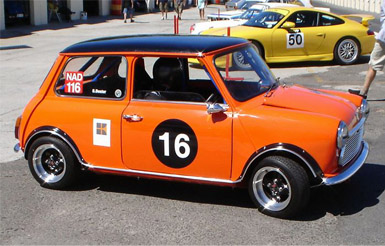
The original Mini (1959–2000) was a revolutionary and distinctive small Automobile/car designed for the British Motor Corporation (BMC) by Sir Alec Issigonis (1906–1988). It was manufactured in Birmingham, England.
Those in the know will point out that the Clubman was the label given to a redesigned Mini in 1969, which aimed to be an upmarket model. That, too, was available as an estate and proved very popular.
Issigonis' friend John Cooper, owner of the Cooper Car Company and Formula 1 Champion in 1959 and 1960, saw the potential of the little car, and after some experimentation and testing, the two men collaborated to create a nimble, economical, and inexpensive car. The Austin Mini Cooper and Morris Mini Cooper debuted in 1962.
Featuring a 1071 cc engine and larger disc brakes, 4,030 Cooper S's were produced and sold until the model was updated in August, 1964. Cooper also produced two models specifically for circuit racing, rated at 970cc and a 1275cc, both of which were also offered to the public. The smaller engine model was not well received and only 963 were built until the model was discontinued in 1965. Over 40,000 1275 cc Cooper S models were produced before this too was discontinued in 1971.
The Mini etched its place into popular culture in the 1960s with well-publicised purchases by film and music stars. Members of the Beatles and even Queen Elizabeth II owned one. Mini Cooper earned acclaim in Monte-Carlo rally victories in 1964, 1965, and 1967. It won in 1966 as well, but was disqualified. The Mini was also arguably the star of the 1969 film The Italian Job.
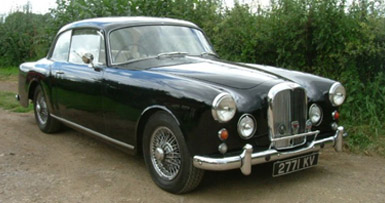
8. Alvis
Alvis made cars from 1920 until 1967. They were relatively expensive when new, and in the upper end of the market, and were not produced in large numbers, which made them very exclusive.
Performance, appearance and finish are all well above the levels found in run of the mill cars. Whilst other makes are better known and more recognised, there is an air of quiet good breeding about an Alvis which expresses its owner's taste.
The nouveau riche needed something flashier and more recognisable than an Alvis to advertise their arrival. Before the Hitler war Alvises were extensively and successfully raced, and competitive appearances continued through the fifties, culminating in the marque's popularity in historic competition today.
All Alvis cars are now desirable classics, with an enthusiastic following. Alvises were not mass produced, rather they were built in batches, with a wide range of models sharing identical mechanical parts. Thus there is an Alvis to suit every temperament and pocket, and the mechanical parts were without exception well made using the very best materials, giving the cars a long service life.
9. Rolls-Royce Phantom II
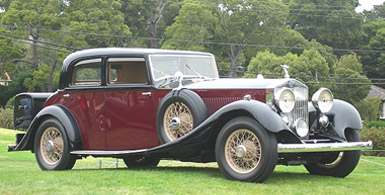
The 1930-1935 Rolls-Royce Phantom II is an updated version of the original.
The new Phantom (Phantom I) of 1925, with a new chassis which is on two long wheelbases and a much more modified engine and transmission.
The Rolls-Royce Phantom II was considered massive in its time, heavy, and very expensive. Performance and economy for this car took a back seat to build quality and luxurious fittings, lending to Rolls-Royce's claim that this was, "The Best Car in the World."
A lower chassis featured four-wheel hydraulic brakes and more modern and hypoid rear end instead of the torque tube used on the Silver Ghost/Phantom I, but the beam-axle suspension front and rear (on semi-elliptic leaf springs) made it somewhat old-fashioned toward the end of the model's life.
Numerous changes occurred, including smaller wheel/tire diameter, one-shot lube system, and synchromesh gearing on third and fourth (from 1932) and on second (1935 models). This model was particularly significant as the last Rolls-Royce designed by Henry Royce.
Special Continental models (280 built) are the most coveted today.
10. Porsche 911
Porsche's classic 911 is still one of the world's great driving experiences. Not many people can afford a new one nor many of us can afford a used.
Pure and simple, this is something pretty thin on the ground these days. Ferry Porsche would probably tell you that in a search for perfection, the motor industry has taken from the driver and given to the machine. Certainly, most of today's cars need far less skill to drive quickly than did their predecessors of the Sixties and early Seventies.
Early 911s had a fearsome reputation for swapping ends on the unwary driver, particularly in the wet.
The post-1989 cars were a great deal better in this respect. The handling is more direct and leaves the driver feeling very much more in control. Play with the throttle during mid-corner lift-off for example, or apply the power with too heavy a touch and there's no punishment, no need for steering correction.
One experienced Porsche owner remarked that he hadn't been very impressed with the car until he took it to a racetrack. Only then did he discover that he simply hadn't been driving it fast enough. One of the most remarkable cars on the road today.